Learn from History: Leadership requires a vision
Sixty-Five years ago, Allied armies under the command of General Dwight D. Eisenhower stormed the beaches at Normandy to liberate Europe and end World War II. This was and still remains one of the most complex military operations ever undertaken. It was planned and executed without the help of modern communications and computers that we now take for granted. So what can we learn from these historical events of over a half century ago that could help us today? Leadership.
The successful Allied invasion was the result of superior leadership starting with General Eisenhower, the Supreme Commander, and continued all the way down to the sergeants and junior officers that led the troops into battle. While the Germans also had some good individual leaders like Field Marshal Erwin Rommel, as a group, the did not share the same vision on how they would defend the beaches. Thus, what started as a foothold on the continent by the Allies grew into a major assault that could not be contained. The leadership provided by General Eisenhower and his subordinates became a major factor as the Allies fought together as a team. The Allies were able to eventually land enough troops and supplies while the Germans could not replace their losses. After some very difficult fighting, the American Third Army under the leadership of General Patton broke through the German lines. Once the breakout occurred the Germans were about to be surrounded. Those that could escape to fight another day retreated while the vast majority were either casualties or became prisoners of war.
The same principles of leadership used by the Allied commanders are universal leadership principles that can applied even today. Given the complex challenges facing the country, it will be excellent leadership that carries us forward to a better day, just as it did sixty-five years ago.
Today more than ever, strong leadership is required to solve the major challenges facing our country and the world. Business leaders need to provide strong leadership to their organizations in a weak economy. Others need to solve major problems on energy, health care, and global warming. Although these historic leadership lessons were forged in the heat of a desperate battle on D-Day, the common element that still remains is human nature. Leadership is the skill that gets things done, solves problems and moves us to a better day. We need effective leaders at all levels and in a cross section of business, non-profit, as well as government enterprises. Thus, the same principles that were used by Allied leaders to achieve victory then, can be used today to lead us forward.
A good example of a leadership principle in action is the concept of “vision.” General Eisenhower provided a vision of his plan for a successful invasion. The plan was known as Operation Overlord. All leaders must have a compelling vision of the future. This defines where they want to go and provides their followers an element of hope of success for the future. Although this is a simple, and perhaps obvious component of good leadership, it is easier said than done. Crafting a compelling vision requires a leader to have a deep understanding of his or her operating environment, the capabilities and limitations of their organization, and a clear understanding of their strategy for moving ahead. Good leaders involve their people to help them develop their vision. This creates organizational buy-in and builds support within the organization. Thus, vision is a fundamental component of good leadership. If you plan to be a successful leader, learn from history and make sure that you have a compelling vision to inspire your followers.
The Supreme Commander: General Dwight D. Eisehhower
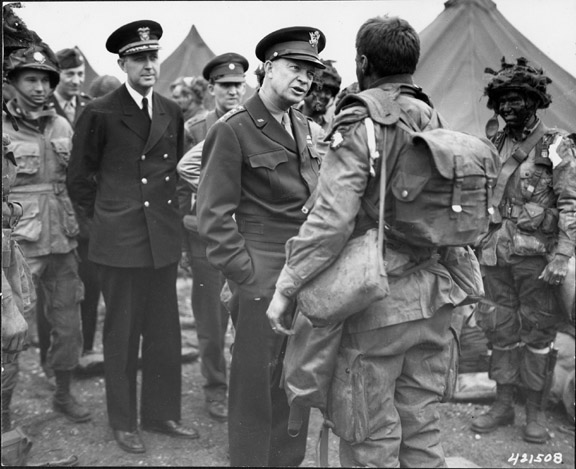
Gen. Eisenhower visits 101st Airborne just before D-Day on June 5th 1944 at their airfield in England
In December 1943, President Roosevelt announced that General Dwight D. Eisenhower would be designated as the Supreme Allied Commander to lead the combined Allied forces for the invasion of Europe on D-Day, June 6th 1944. Eisenhower graduated from the US Military Academy at West Point with the Class of 1915. He began his military career in the infantry and served stateside during World War I, much to his chagrin. He later was assigned to served in the new tank corps and after the war was over, developed a close friendship with a fellow tank corps officer, George S. Patton. Like many officers in the post World War I army, his career progression stagnated; however he made some close associations with mentors like General Fox Conner and later General Douglas MacArthur whom he accompanied to the Phillipines when MacArthur retired from the US Army to train the Philippine Army. Eisenhower also distinguished himself by graduating first in his class at the army Command and General Staff College at Ft. Leavenworth, Kansas.
When World War II began in Europe, Eisenhower was reassigned back to the US and after a series of assignments was brought to Washington DC to serve under the Army Chief of Staff, General George C. Marshall, as the head of the War Plans Divsion. He was quickly promoted to Brigadier General in this assignment, and although he was a relatively junior general officer, he demonstrated his ability not only for planning, but more importantly for dealing with people who had strong personalities and were often senior in rank. These were leadership qualities that were noticed by General Marshall and at his urging to President Roosevelt and Prime Minister Churchill, General Eisenhower was selected to command the first combined British and American operation for the invasion of North Africa. As the Commander for Operation Torch and the subsequent Operation Husky to invade Sicily, Eisenhower demonstrated his remarkable skill for fostering teamwork among the Allied commanders. This skill for handling the strong personalities of the different commanders and forging them into a cohesive team was the primary factor for his selection as the Supreme Commander for the invasion of France in 1944. No other general, either American or British, with the possible exception of Marshall himself, could effectively lead the coalition. Although Eisenhower’s patience was tested on many occasions, it was his ablitly to build and maintain an effective team that was more important to his success than technical war-fighting skills. He deserves much credit for the final victory in Europe for this leadership ability to forge an effective team which is immeasurably more difficult when your command is a combined Allied force. Although other generals often were getting headlines for the exploits of their units, it was Eisenhower at the helm that made the combined Allied effort effective.
You can read more about Eisenhower’s career both during and after the war at the following link: http://en.wikipedia.org/wiki/General_Eisenhower
Why is leadership so important today?
Why is leadership so important today? This may seem like an obvious question when America is faced with significant challenges at home and abroad; however, in times of crisis, strong leadership is the decisive factor in driving the changes that are needed to get us to a better day. In military terms, strong leadership is recognized as a “force multiplier” and can influence the outcome of the battle. On the economy, international issues, and a host of domestic policies ranging from health care, education, and energy America needs strong leadership. We need strong leadership not just at the top, but at every level. We need leaders to step forward with creative ideas and new approaches. Throughout our history, America has been fortunate to have leaders step forward to deal with formidable problems, just as the men and women of the “Greatest Generation” stepped forward to deal with the challenges of the Great Depression and World War II. It was strong leadership then that got us through those tough challenges, and it will be a new generation of leaders today who will solve our nation’s current problems. These new leaders can learn from history and apply bedrock leadership principles that will make a difference. These are the principles that I call the “VICTORY Principles.”
The word “VICTORY” is actually a simple way to remember each of these principles. Each letter stands for one of the principles. Future posts will describe each of these principles in more detail. Check back and learn more about each of the principles and how you can apply them in your own leadership journey.
Written in the format of a Staff Ride
VICTORY PRINCIPLES is written in the three part format of a Staff Ride, the same technique used to train army officers. A staff ride focuses the study of history on leadership “lessons learned” that can be applied in the future. Part one of this book is the fascinating story of D-Day itself. Part two describes seven timeless leadership lessons, the VICTORY PRINCIPLES. Part three is a guide to the battlefield sites on the northern coast of France and what you would find there today.
Staff Rides were originated in the 19th century by the German army to train their general staff officers. General staff officers studied and visited the European battlefields from the Napoleonic Wars to deduce lessons learned for the future. The Staff Ride methodology was later adopted by the US Army prior to World War I when officers attending advance military schooling studied Civil War battles and subsequently made on-site visits. Their visits helped to visualize and understand the lessons learned by walking the actual terrain of the battlefield. Today, Staff Rides are still a popular teaching technique used at the US Army Command and Staff College at Ft. Leavenworth, KS. and by other military agencies.
D-Day 65th Anniversary Edition Coming Soon!
VICTORY Principles is the title of a new book that will be published later this year about the D-Day invasion in Normandy, France on June 6, 1944. This book focuses on the leadership lessons learned through the examination of this historical event,one of the most important events of World War II. This year will mark the 65th anniversary of D-Day. Check back here to learn more about the VICTORY Principles and D-Day.


